Engineering wins too
What never touches the ball.
Millions of people are watching the world's biggest game this summer. We're watching the technology behind it.
From smart match balls and AI-powered officiating to computer vision and performance analytics, elite football has become a showcase for hardtech. This week, we explore the engineering behind the beautiful game, and the Nordic innovators helping move it forward.
Nordic Hardtech Partners 🤝

- Lightbringer: AI-powered patent service helping tech companies protect their edge fast, with in-house legal expertise. Book an intro.
- Recuro: Growth partner for hardtech and deeptech. Scale with profit.
- SISP (Swedish Incubators & Science Parks): The network for 60+ incubators and science parks in Sweden. Find yours here.
- The Yard: Gothenburg’s hub for co-working, community, and serious hardware. Explore their memberships.
Nordic Hardtech Outlook
This week: The hardtech powering the beautiful game.⚽️
The game beneath the game
Elite football has become one of the world's toughest proving grounds for new technology. Systems must perform flawlessly, in real time and under the scrutiny of millions, making the sport an unlikely but valuable testbed for hardtech innovation.
To most fans, football is still a game of tactics, talent and unforgettable goals. Behind every match, however, lies a sophisticated technology stack.
Cameras track every movement. Embedded sensors inside the ball record contact points in real time. AI supports referees with split-second decisions, while wearables shape how players train, recover and avoid injury.
According to the latest Technology SPARK report from the World Intellectual Property Organization (WIPO), sports-related patent filings grew by 7.6% annually between 2016 and 2025, compared with 4.4% across patents overall. Football reflects that trend, with technologies first developed for manufacturing, robotics and industrial sensing now finding applications on the pitch before spreading into other industries.
The extra pair of eyes
VAR may be the technology most fans recognise, but it's only one layer of a much larger technology stack.
Modern football relies on computer vision to track players, analyse movement and generate insights that simply weren't possible a decade ago. The underlying capabilities are already familiar to anyone working with industrial inspection, autonomous systems or smart manufacturing.
Sweden's Spiideo has become one of the global leaders in AI-powered sports video, replacing traditional camera operators with automated computer vision systems. Its acquisition of Swedish player-tracking specialist Signality further strengthened the platform's performance analytics capabilities.

The pitch may be unique, but the engineering challenges are surprisingly familiar.
An edge device
The official match ball has evolved into far more than a piece of sports equipment.
An inertial measurement unit (IMU) records movement hundreds of times every second. Combined with AI and tracking cameras, it determines the exact moment a player touches the ball, making semi-automated offside decisions faster and more consistent.
From a hardtech perspective, it's a compact edge device, combining sensing, embedded electronics and real-time processing in one of the world's harshest deployment environments.
Measurable performance
Wearables, GPS systems and biometric sensing have transformed player development into a continuous stream of data. According to WIPO, performance tracking and monitoring account for roughly one-third of all football-related patent activity, making it the sport's largest area of innovation.
Finland's Polar pioneered wearable sensing decades before "sports tech" became an industry. Today, many of the same technologies are used in healthcare, rehabilitation and occupational health, illustrating how elite sport can accelerate innovation far beyond the pitch.
An intelligent environment
Modern football stadiums have become intelligent environments where connectivity, broadcasting, security and real-time data are as essential as the action on the pitch. High-capacity networks power everything from live production and fan experiences to venue operations, while cameras and sensors help monitor safety and crowd movement.
Nordic companies are helping shape this transformation. Norway's Vizrt is a global leader in live graphics and broadcast technology, enabling rights holders to combine real-time data with immersive viewing experiences. Swedish Axis Communications supplies intelligent network camera systems used in major venues around the world, bringing technologies developed for critical infrastructure into elite sport.
...and a proving ground
Perhaps that's the biggest lesson for the hardtech community. Elite football demands the same things as any industrial customer: precision, reliability, low latency and systems that cannot fail under pressure, only under the scrutiny of millions of viewers.
Computer vision refined on the pitch can improve industrial inspection. Wearable sensing developed for athletes can support healthcare and worker safety. Embedded systems designed for connected sports equipment can inspire new industrial applications.
The technologies flow in both directions. For hardtech companies, football is no longer just a sports market. It's another demanding customer, pushing AI, sensing, computer vision and embedded systems into new territory.
May the best technology win.
- Europe wants more rockets of its own. Sting has invested in Swedish-American Pythom Space, backing affordable launch technology and stronger European space sovereignty. Learn more.
- Road charging is gaining momentum. Elonroad has secured SEK 90 million to accelerate deployment of its in-road charging technology, with ports and logistics hubs among its first target markets.
Listen to our podcast interview (in Swedish) with Elonroad CEO Karin Ebbinghaus about the future of in-road charging and what's needed to scale hardware innovation in transport.
- Sweden is doubling down on batteries. Vinnova is investing SEK 316 million to strengthen the entire battery value chain, from testing and industrial scale-up to recycling and new business models.
- Stilfold has secured up to SEK 22 million in EU funding to scale its industrial origami technology, reducing material waste and production costs in manufacturing.
- Swedish defence tech is joining forces. Nordic Air Defence and Polar Mist Technologies are partnering to develop an autonomous maritime air defence system, combining defence drones with uncrewed surface vessels for Baltic security.
What's brewing in the community?
- ICEYE is hiring a Senior System Engineer in Espoo. Join one of Europe's fastest-growing space and defence tech companies to build mission-critical ground systems for the world's largest commercial SAR satellite constellation. Apply here. (Fresh off a €450M Series F at a €10B valuation.)
- Heading to Almedalen? (June 22–26) Science Park Gotland and Hite Incubator are among the many ecosystem players hosting sessions on AI, electric aviation, energy and innovation throughout the week. Explore the programme.
- Quantum tech takes centre stage in Oslo on June 22–24. IQT Nordics 2026 brings together founders, researchers, investors and industry leaders to explore the commercialisation of quantum technologies. Sign up.
- As always, check out our Nordic Hardtech Event Map for 2026 for more hardtech events across the Nordics and beyond.
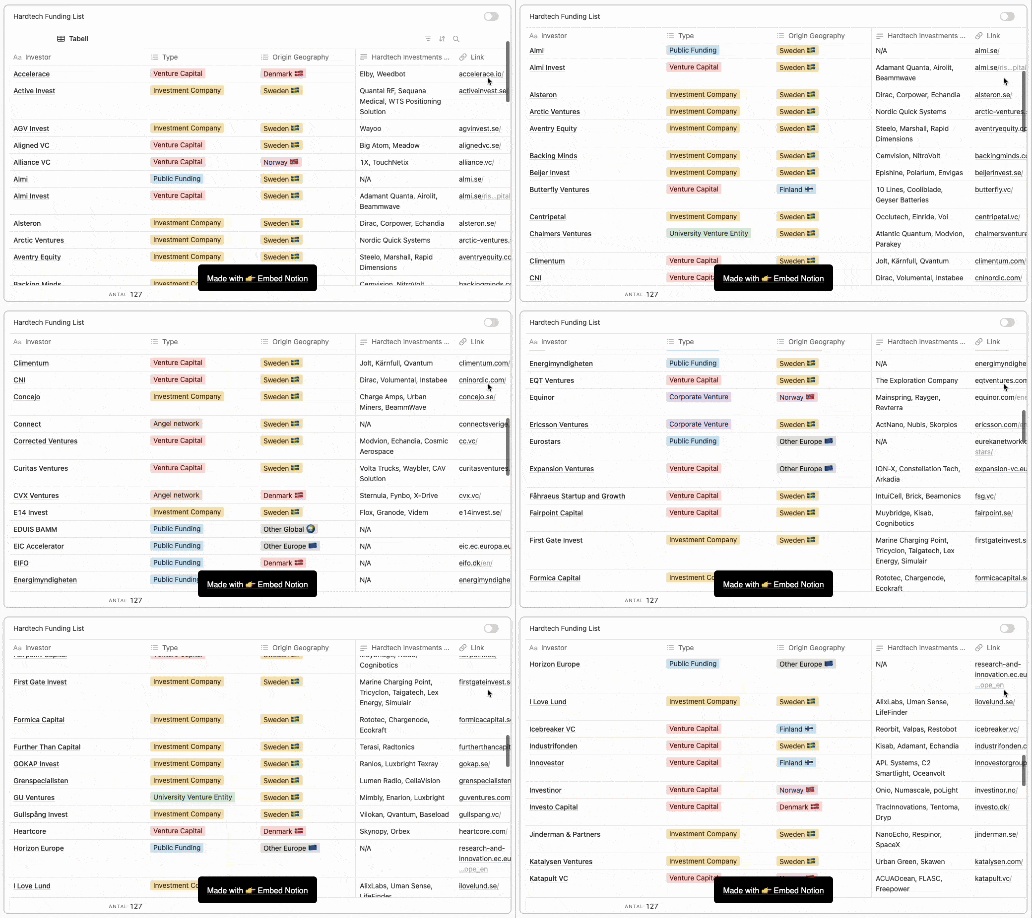
Nordic Hardtech Funding List
See who’s raising, scaling and building across the Nordics.
Nordic Hardtech is a platform for the hardtech ecosystem — sharing knowledge, bringing inspiration, and building community through podcasts, newsletters, events, and more.
💸 Fuel up. Scaling takes capital — The Nordic Hardtech Funding List shows you where to find it.
💥Get involved. Pitch a topic. Join the podcast. Get on the investor list– if you're hardtech.
→ Spotify | LinkedIn | nordichardtech.com
📩 hello@nordichardtech.com
    <picture><img class="kg-signup-card-image" src="/images/content/f227326276-Nordic-Hardtech---Digital-assets--square---5-.png" alt=""></picture>

        <div class="kg-signup-card-content">

            <div class="kg-signup-card-text ">
                <h2 class="kg-signup-card-heading"><span>Sign up for Nordic Hardtech</span></h2>
                <p class="kg-signup-card-subheading"><span>The platform for leaders of hardtech</span></p>

    <form class="kg-signup-card-form" method="post" action="https://nordichardtechnvotf6lc-forms.functions.fnc.fr-par.scw.cloud/">
        <div class="kg-signup-card-fields">
            <input class="kg-signup-card-input" name="email" type="email" required placeholder="Your email">
            <input type="text" name="website2" tabindex="-1" autocomplete="off" style="position:absolute;left:-9999px" aria-hidden="true">
            <button class="kg-signup-card-button kg-style-accent" type="submit">Subscribe</button>
        </div>
    </form>

                <p class="kg-signup-card-disclaimer"><span>Don't worry it's free. No spam. Unsubscribe anytime. </span></p>
            </div>
        </div>
    </div>