Fifty issues in
AI is leaving the screen
For 49 issues, some themes kept resurfacing: industrial AI, robotics, resilience, manufacturing and Europe’s race to stay competitive.
For issue #50, Mala Valroy, General Partner at ThursdayVC, a Physical AI-focused fund backing European founders from the earliest stages, joins Nordic Hardtech with a guest column on Europe, China and the next deeptech battleground.
Because AI is no longer just a software story. It’s increasingly becoming a question of factories, infrastructure, automation and who gets to build the systems behind them.
Nordic Hardtech Partners 🤝
- Lightbringer: AI-powered patent service helping tech companies protect their edge fast, with in-house legal expertise. Book an intro.
- Recuro: Growth partner for hardtech and deeptech. Scale with profit.
- SISP (Swedish Incubators & Science Parks): The network for 60+ incubators and science parks in Sweden. Find yours here.
- The Yard: Gothenburg’s hub for co-working, community, and serious hardware. Explore their memberships.
Nordic Hardtech Guest Column
This week: Mala Valroy on Physical AI, Europe and the next industrial race.
Deep Tech Needs to Go Deeper (Except Here)
by Mala Valroy, investor and General Partner at ThursdayVC.
The debate around European deep tech competitiveness seems to have collapsed into two camps. Either Europe should accept its “museum” reputation and become a fast follower, or we just need to throw enough money at the problem to make it disappear.
There is a third, more tactical option: build where we can actually be competitive.
China has already won the unit economics battle in several critical hardware categories. That’s what two decades of industrial policy, vertically integrated supply chains and brutal domestic competition can produce.
At the same time, too many Nordic AI startups are still building thin software layers on top of American models or Chinese hardware, instead of digging deeper into the tech stack where the moat and long-term value sit.
Here are three areas where the Nordics still have a genuine opportunity to differentiate:
Physical AI and Robotics
A few days ago, Genesis AI unveiled GENE-26.5, a robotics foundation model designed to close the sim-to-reality gap for dexterous manipulation with remarkable accuracy. The robotic hand in the demo was built by Chinese manufacturer Wuji Tech. Yet there is still no Chinese full-stack offering that comes close to what Genesis demonstrated.
The opportunity is not to train AI for narrow commercial applications
For Nordic founders, the opportunity is not to train AI for narrow commercial applications. It is to close other sim-to-reality gaps across multiple verticals.
Another strategic path is modular manufacturing. Instead of relying on rigid production lines, companies can build flexible assembly systems using proprietary AI and cost-effective components. Firms capable of producing drones, robotic arms or humanoids on flexible infrastructure are competing in a very different category than highly streamlined Chinese mass production.
There is also a massive opportunity in high-mix, low-volume manufacturing, the reality for much of Europe’s SME-heavy industrial base and still one of the hardest environments for robotics deployment.
Quantum
IQM remains one of the rare Nordic exceptions positioned to compete globally in quantum hardware. But Europe has fragmented its efforts instead of building connected ecosystems.
The strongest opportunity is probably not in the race for the best general-purpose qubit. It is in vertical applications such as drug discovery, materials simulation and logistics optimization.
Financing, however, has not followed.
The Nordic industrial base already leans in this direction. Companies like Novo Nordisk, Atlas Copco and Ericsson understand the value of deep industrial applications. Financing, however, has not followed. Europe still attracts only around 5% of global private quantum investment, compared to roughly 50% in the US.
If Europe wants a real position in quantum hardware, photonics may be one of the clearest paths forward, and Nordic research is already strong in this field.
Biomanufacturing
China controls roughly 70% of global fermentation capacity, so competing on scale is unrealistic. The Nordic advantage lies elsewhere: precision fermentation for high-margin specialty products.
Advanced pharmaceuticals, rare enzymes and bio-based industrial materials have taken a hit in investor sentiment recently, partly due to FDA uncertainty and broader anti-climate rhetoric. But Nordic biofoundries offering data-sovereign, regulatory-compliant alternatives to Chinese CDMOs still have a tangible and growing market opportunity.
One Area We Should Stop Pretending
There are also areas where Europe needs to stop pretending it will catch up. Batteries are one of them.
Europe, and particularly the Nordics, are structurally behind China in battery chemistry and manufacturing scale. Solid-state batteries are unlikely to become the redemption arc many hoped for, especially as China continues setting the pace in deployment.
The Nordics do not need to win everywhere.
This is one area where Europe should move up the stack instead: battery management systems, degradation modelling, second-life qualification, recycling and critical mineral recovery.
The Nordics do not need to win everywhere. They just need to win somewhere defensible. That requires a smaller map than many policymakers want to draw, but it is also a far clearer one.
Mala Valroy also joined the Nordic Hardtech Podcast i October 2025.
- Sweden wants factories to behave more like smart grids. A new 320 MSEK initiative will test AI-controlled flexibility, energy sharing and digital twins in real industrial environments.
- Europe wants battery sovereignty, China wants market share. Norwegian battery startup Morrow just became the latest casualty in between, now filing for bankruptcy.
- Helsing, backed by Daniel Ek, is reportedly raising another $1.2B at an $18B valuation as investors continue pouring into defence AI.
- While batteries store hours, Photoncycle wants to store seasons. The Norwegian startup has raised €15M for a hydrogen-based home energy system claiming 10,000 kWh capacity.
- Europe’s defence buildup now includes TNT factories. Swedish startup Swebal has raised €30M to help reduce NATO’s dependence on imported energetic materials.
What's brewing in the community?
- FREYA IS HIRING. The Stockholm startup building AI-enabled sensors for security and critical infrastructure is now looking for its first core engineers. Open roles include embedded hardware and embedded software engineers. Apply here!
- Resilience Tech-X Day 2026 is bringing together startups, investors and ecosystem players around defence, dual-use, cybersecurity and space tech. The event takes place in Stockholm on May 20. Sign up here.
- Techarena is going global. The Swedish platform is launching an investor-focused tour across six international tech hubs, including London, Copenhagen, Paris and San Francisco.
- For more hardtech events across the Nordics and beyond, check out our Nordic Hardtech Event Map for 2026. The list is continuously updated — feel free to send in tips!
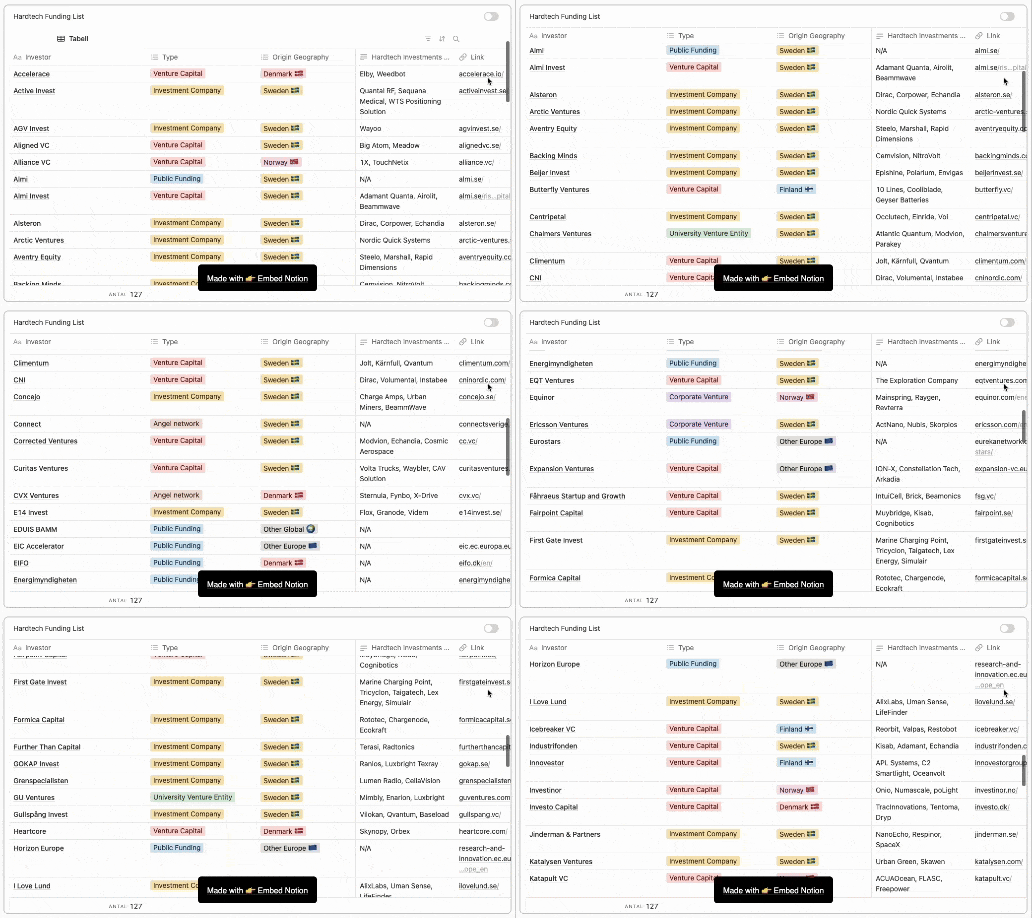
Nordic Hardtech Funding List
See who’s raising, scaling and building across the Nordics.
Nordic Hardtech is a platform for the hardtech ecosystem — sharing knowledge, bringing inspiration, and building community through podcasts, newsletters, events, and more.
💸 Fuel up. Scaling takes capital — The Nordic Hardtech Funding List shows you where to find it.
💥Get involved. Pitch a topic. Join the podcast. Get on the investor list– if you're hardtech.
→ Spotify | LinkedIn | nordichardtech.com
📩 hello@nordichardtech.com
    <picture><img class="kg-signup-card-image" src="/images/content/f227326276-Nordic-Hardtech---Digital-assets--square---5-.png" alt=""></picture>

        <div class="kg-signup-card-content">

            <div class="kg-signup-card-text ">
                <h2 class="kg-signup-card-heading"><span>Sign up for Nordic Hardtech</span></h2>
                <p class="kg-signup-card-subheading"><span>The platform for leaders of hardtech</span></p>

    <form class="kg-signup-card-form" method="post" action="https://nordichardtechnvotf6lc-forms.functions.fnc.fr-par.scw.cloud/">
        <div class="kg-signup-card-fields">
            <input class="kg-signup-card-input" name="email" type="email" required placeholder="Your email">
            <input type="text" name="website2" tabindex="-1" autocomplete="off" style="position:absolute;left:-9999px" aria-hidden="true">
            <button class="kg-signup-card-button kg-style-accent" type="submit">Subscribe</button>
        </div>
    </form>

                <p class="kg-signup-card-disclaimer"><span>Don't worry it's free. No spam. Unsubscribe anytime. </span></p>
            </div>
        </div>
    </div>