Power shifts.
From markets to mandates.
For a long time, industrial policy was something founders often adapted to after the fact. Rules were read, boxes were ticked, and products were adjusted once the market was already in motion. That logic no longer holds.
Today, public funding, regulation and state procurement shape what gets built, how it’s financed and who gets to scale. Policy is no longer background context. It’s part of the design space. This issue explores what that means in practice for Nordic hardtech founders.
Nordic Hardtech Partners 🤝

- Lightbringer: AI-powered patent service helping tech companies protect their edge fast, with in-house legal expertise. Book an intro.
- Recuro: Growth partner for hardtech and deeptech. Scale with profit.
- SISP (Swedish Incubators & Science Parks): The network for 60+ incubators and science parks in Sweden. Find yours here.
- The Yard: Gothenburg’s hub for co-working, community, and serious hardware. Explore their memberships.
Nordic Hardtech Analysis
This week: The price of policy-backed funding?
When policy becomes a product constraint
Industrial policy is no longer something founders navigate after the product exists. Public funding, regulation and state procurement now influence product decisions much earlier. The real challenge is not access to support, but how much strategic control founders are willing to trade for it.
For a long time, public frameworks largely remained outside the core of company building. Founders focused on customers, capital and delivery, while regulation and public funding were treated as constraints to manage later. That distinction has eroded.
Across the Nordics and the EU, public actors are intervening earlier and more deliberately. Funding is targeted at specific technologies. Regulatory requirements are embedded into product definitions. And in many cases, the state is no longer just a rule-setter, but an active force shaping direction and pace.
Why policy now reaches upstream
The rationale behind this shift has been made explicit by public actors themselves. Speaking about the role of deeptech in Europe’s industrial competitiveness, Josefin van der Meer, national contact person for international deeptech cooperation at Vinnova, puts it plainly:
– Deeptech companies have great potential to contribute to solving the societal challenges we face today. Deeptech innovations require a lot of capital combined with specialised technical and commercial expertise, even in early development phases. Therefore, it is especially important to create the right conditions so that the companies can survive and remain in Sweden and the EU.
That framing helps explain why public funding now reaches further upstream. In capital-intensive areas such as materials, energy systems and industrial infrastructure, state support can unlock development paths that private capital would otherwise avoid. Projects that would stall early get a runway long enough to prove technical and industrial viability.
Eligibility shaping roadmaps
However, trade-offs surface early. Roadmaps start aligning with calls rather than customers. Reporting requirements grow. Iteration slows as compliance increases. Teams spend more time justifying progress than testing assumptions. Over time, the logic of eligibility can begin to outweigh the logic of demand.
These tensions become even sharper when the state occupies multiple roles at once. As regulator, it defines the rules of the market. As funder, it shapes incentives. As customer, it sets procurement criteria that often ripple far beyond individual contracts.
At the EU level, this is no longer framed as a temporary response, but as a long-term necessity. Speaking to Reuters in early 2026, EU industry commissioner Stéphane Séjourné was blunt about the stakes:
– Without an ambitious, effective and pragmatic industrial policy, the European economy is doomed to be just a playground for its competitors.
Large-scale industrial projects like Stegra illustrate how powerful alignment between policy, capital and technology can be. Political backing, regulatory clarity and long-term guarantees make it possible to pursue projects of a size and risk profile few private investors would accept on their own.
How much control to trade?
At the same time, such cases highlight a growing divide. Some companies are built to fit national strategies and public frameworks from day one. Others are built to chase global markets first, and adapt to policy later. The two paths require very different operating models, governance structures and definitions of success.
For founders, the question isn't whether to engage with industrial policy, but how deliberately to do so. Some teams isolate policy-driven development from their core product. Others treat public funding as a bridge rather than a foundation. The most resilient companies tend to design optionality into both their technology and organisation early on.
Industrial policy isn’t going away. The real advantage lies in knowing when to use it as leverage, and when it starts dictating decisions you should be making yourself.
Lately ⏮️
Selected news from the hardtech ecosystem
- A new ClimateHack report maps 100 Climate HardTech opportunities for 2026, identified by 35 European investors. Focus areas include AI-driven electrochemistry, regenerative supply chains and scalable bioplastics.
- European venture investment hit record levels in 2025, driven by AI and defence, with space and drone startups among the biggest beneficiaries. The surge reflects a broader European push into strategic deeptech.
- A new deep dive maps humanoid robotics down to screws, bearings and battery chemistry. While the US and China dominate the story, key components still trace back to Europe’s industrial base, including players like SKF.
- Stegra has named a new CFO as it prepares for its next funding phase. Policy alignment got it here. Capital discipline will take it further.
Up next ⏭️
What's brewing in the community?
- Tonight in Stockholm! Founders, engineers and designers are gathering at Builders House (18–21) for a relaxed meetup after Tech Arena – no agenda, just people building and swapping what they’re shipping. Sign up!
- The EU has opened a new “European Startup and Scaleup Hubs” call to strengthen deeptech ecosystems and cross-border scale across Europe. Deadline 10 March 2026.
- Tibber is hiring a Head of Hardware to lead development of Pulse, Homevolt and future connected energy products. A senior role shaping consumer-facing hardware in the energy transition. Read more and apply.
- Elekta is hiring a Head of Engineering in Stockholm to lead its Neuro Solutions product portfolio, technology roadmap and IP strategy. A senior MedTech hardware leadership role. Apply here.
- For more hardtech events across the Nordics and beyond, check out our Nordic Hardtech Event Map for 2026. The list is continuously updated — feel free to send in tips if there’s an event we should include.
 Jennifer Bark
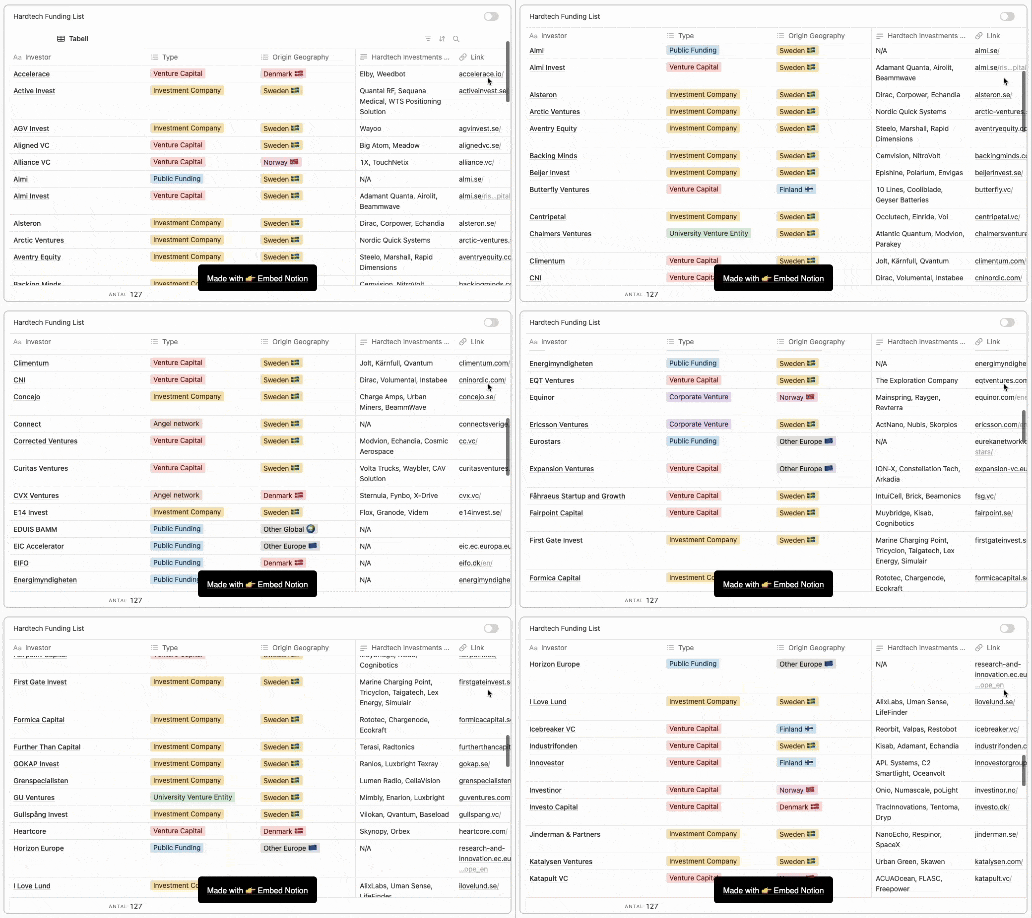
Nordic Hardtech Funding List
See who’s raising, scaling and building across the Nordics.
Nordic Hardtech is a platform for the hardtech ecosystem — sharing knowledge, bringing inspiration, and building community through podcasts, newsletters, events, and more.
💸 Fuel up. Scaling takes capital — The Nordic Hardtech Funding List shows you where to find it.
💥Get involved. Pitch a topic. Join the podcast. Get on the investor list– if you're hardtech.
→ Spotify | LinkedIn | nordichardtech.com
📩 hello@nordichardtech.com