At the edge.
Where systems meet behavior.
When animals move through roads, railways and airports, infrastructure has to respond to living behavior — fast, locally and without room for error.
In this issue, we speak with Tomas Becklin, CTO and co-founder of Flox, about building edge-based hardware that guides animal behavior using sound. It’s a conversation about autonomy, constraints and what it really takes to deploy AI in unpredictable, safety-critical environments.
Nordic Hardtech Partners 🤝

- Lightbringer: AI-powered patent service helping tech companies protect their edge fast, with in-house legal expertise. Book an intro.
- Recuro: Growth partner for hardtech and deeptech. Scale with profit.
- SISP (Swedish Incubators & Science Parks): The network for 60+ incubators and science parks in Sweden. Find yours here.
- The Yard: Gothenburg’s hub for co-working, community, and serious hardware. Explore their memberships.
Nordic Hardtech Podcast 🎧
This week: Edge hardware meets wildlife through Swedish Flox.
Teaching infrastructure to speak animal
When wildlife enters roads, railways and airports, the consequences are immediate. Flox CTO Tomas Becklin explains how edge hardware, acoustics and AI are being used to guide animal behavior where infrastructure can’t afford hesitation.
Wildlife doesn’t respect system boundaries. It moves when it moves, often into places built for speed, predictability and flow. Roads, railways and airports were never designed to negotiate with living behavior, yet that is increasingly what they are forced to do.
– We like to say that we actually speak to animals using a language they understand, says Tomas Becklin, CTO and co-founder of Flox.
The idea behind Flox is deceptively simple: Identify the animal. Understand its behavior. Respond with a sound the animal instinctively recognizes. No fences, no physical barriers, no mechanical shock. Just a signal that makes sense to the animal in that moment.
"They quickly become limiting factors"
Flox’s systems use onboard AI to infer both species and behavior in real time. Based on that assessment, the device plays an acoustic signal designed to trigger a natural response, guiding the animal away from sensitive infrastructure.
– We’re not trying to scare animals. We’re trying to give them a signal they already understand, says Tomas.
The concept grew out of early research and drone experiments, initially aimed at keeping wild boars away from farmland. At the time, drones seemed like a flexible way to cover large areas and react dynamically.
– Drones were useful for exploration, but they’re hard to scale commercially. Regulation, operations and reliability quickly become limiting factors, says Tomas.
That insight pushed the team in a different direction. Instead of something that moves, Flox began building something that could stay put: a small, autonomous edge device designed for permanent installation.
Most of the time, it sleeps
Mounted near roads, railways or airport perimeters, the device sits quietly in the landscape. It has no visible signals and no constant connection to the cloud. Most of the time, it sleeps.
– The system has to be invisible until it matters. When something happens, it needs to wake up, understand the situation and respond immediately, Tomas explains.
Those requirements place hard constraints on the hardware. Flox ruled out Linux-based boards early due to boot times and power consumption. Instead, the system runs on microcontrollers, optimized to remain dormant until something actually happens.

Motion detection became another bottleneck. Early prototypes covered too little ground, which would have required large numbers of devices to protect real infrastructure.
– We knew we had to extend the range significantly, Becklin says. – Otherwise the system wouldn’t be viable in practice.
"We’re seeing success rates around 95 percent"
By redesigning sensor placement and optics, the team significantly increased the effective range, a solution that is now patent-protected. In field deployments, the results have been strong.
– With our edge system, we’re seeing success rates around 95 percent, Becklin says.
Today, Flox’s primary customers are infrastructure owners such as transport authorities and airports, where wildlife incidents translate directly into safety risks and operational costs. That context has also shaped how the company thinks about value.
– Customers aren’t buying a box. They’re buying access to a wildlife platform, says Tomas.
That focus on outcomes over hardware has influenced more than pricing. It has also shaped how Flox builds and tests new systems, with an emphasis on speed and real-world feedback over polish.
– You need to get to a prototype as quickly as possible. Before that, you don’t really have anything.
Catch the full interview with Tomas Becklin from Flox on Spotify.
Lately ⏮️
Selected news from the hardtech ecosystem
- Techarena has announced its TOP46 finalists for 2026. Among them, hardtech contenders include Physical Robotics, NitroVolt and TioTech, spanning robotics, energy and advanced materials ahead of the February finals in Stockholm.
- Finland is doubling down on semiconductors and quantum, tying national research assets closer to startups and industry to accelerate deeptech scale-up, according to Business Finland.
- VTT LaunchPad has joined the DeepTech Alliance, strengthening cross-border pathways for research-driven hardtech spin-outs scaling in Europe.
- Susanne Najafi, named a top female investor by Dagens industri, said at the Nordic Scaleup Awards that the Nordics outperform Europe but fragmented capital markets still slow scale-ups.
- Nordic Innovation and partners have launched the Nordic AI & Quantum Node to strengthen Nordic collaboration in applied AI and quantum,with a clear push toward faster industry adoption by aligning ecosystem actors across Sweden, Finland, Norway and Denmark.
Up next ⏭️
What's brewing in the community?
- The 4th Hardware Tech & Design event lands in Stockholm on Feb 11, bringing speakers from Toyota Motor Europe, Decathlon, Encube and more to explore tech in the physical world. Sign up!
- STARK is opening an office in Stockholm. The defence and unmanned systems company cites Sweden’s engineering talent and strategic role in Europe as key drivers for its Nordic expansion.
- Vinnova and Swedish Research Council will open a joint call in April to fund excellence clusters spanning research and innovation, with early information and info sessions available this spring.
- IQT Nordics 2026, a three-day quantum technology conference focusing on commercialization and industrial applications, will take place in Oslo from June 22-24, offering networking and insights into scaling quantum tech.
- For more hardtech events across the Nordics and beyond, check out our Nordic Hardtech Event Map for 2026. The list is continuously updated — feel free to send in tips if there’s an event we should include.
 Jennifer Bark
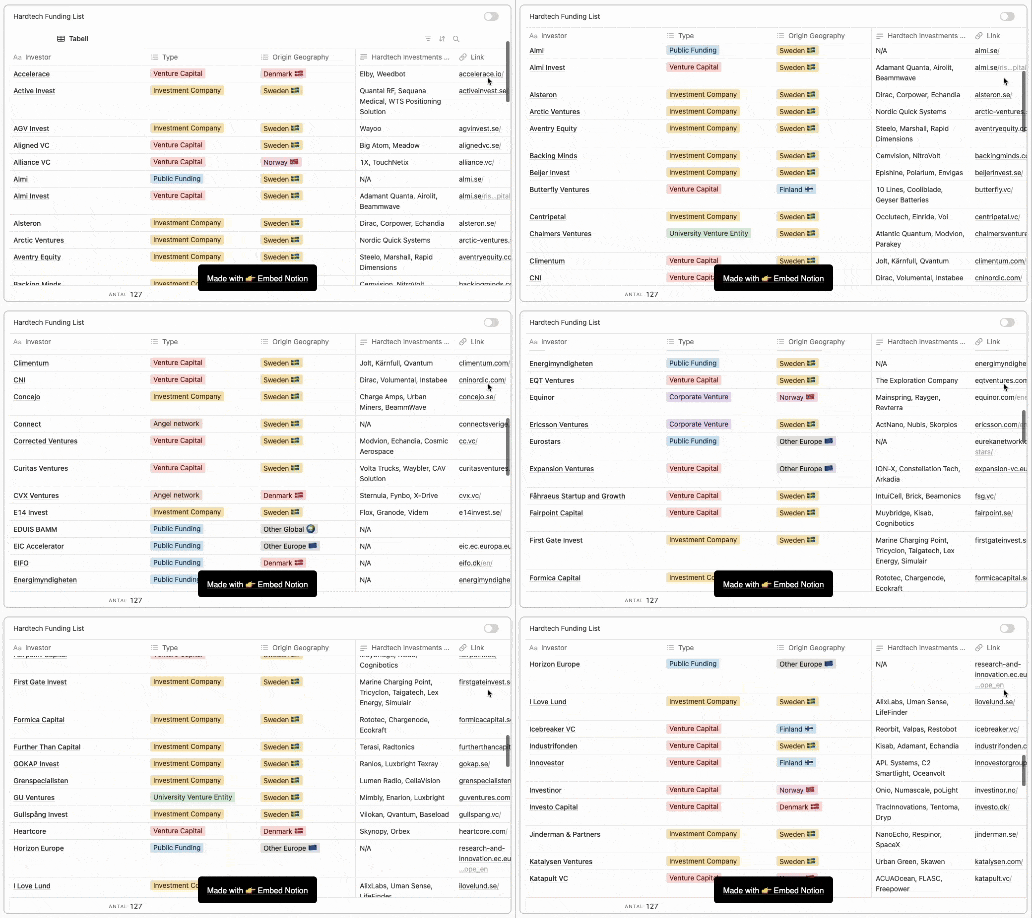
Nordic Hardtech Funding List
See who’s raising, scaling and building across the Nordics.
Nordic Hardtech is a platform for the hardtech ecosystem — sharing knowledge, bringing inspiration, and building community through podcasts, newsletters, events, and more.
💸 Fuel up. Scaling takes capital — The Nordic Hardtech Funding List shows you where to find it.
💥Get involved. Pitch a topic. Join the podcast. Get on the investor list– if you're hardtech.
→ Spotify | LinkedIn | nordichardtech.com
📩 hello@nordichardtech.com