Too many ideas.
Too few deployments.
Europe doesn't suffer from a lack of deeptech ideas. It suffers from a lack of industrial follow-through. In this week’s edition, we lead with a guest column that goes straight at the bottleneck most founders already feel, but few incumbents openly address. As deeptech moves from lab to factory floor, too many promising technologies stall in the same place. Not because the science fails, but because the machinery for scaling never fully engages.
This is a sharp, experience-driven argument for why Europe’s legacy industry must stop waiting for “finished” technology and start taking responsibility earlier in the journey.
Nordic Hardtech Partners 🤝
- Lightbringer: AI-powered patent service helping tech companies protect their edge fast, with in-house legal expertise. Book an intro.
- Recuro: Growth partner for hardtech and deeptech. Scale with profit.
- SISP (Swedish Incubators & Science Parks): The network for 60+ incubators and science parks in Sweden. Find yours here.
- The Yard: Gothenburg’s hub for co-working, community, and serious hardware. Explore their memberships.
Nordic Hardtech Guest Column
This week: What must be done differently
The Deeptech Funnel: Why European Legacy Industry Must Stop Being a Spectator
by Magnus Ahlstedt, Industrial deployment lead
For more than two decades, I have navigated the industrial trenches of Europe, working at the high-friction interface where emerging deeptech meets the reality of product deployment. I have seen the same pattern repeat across the continent: brilliant science stalling because the machinery for scaling is broken.
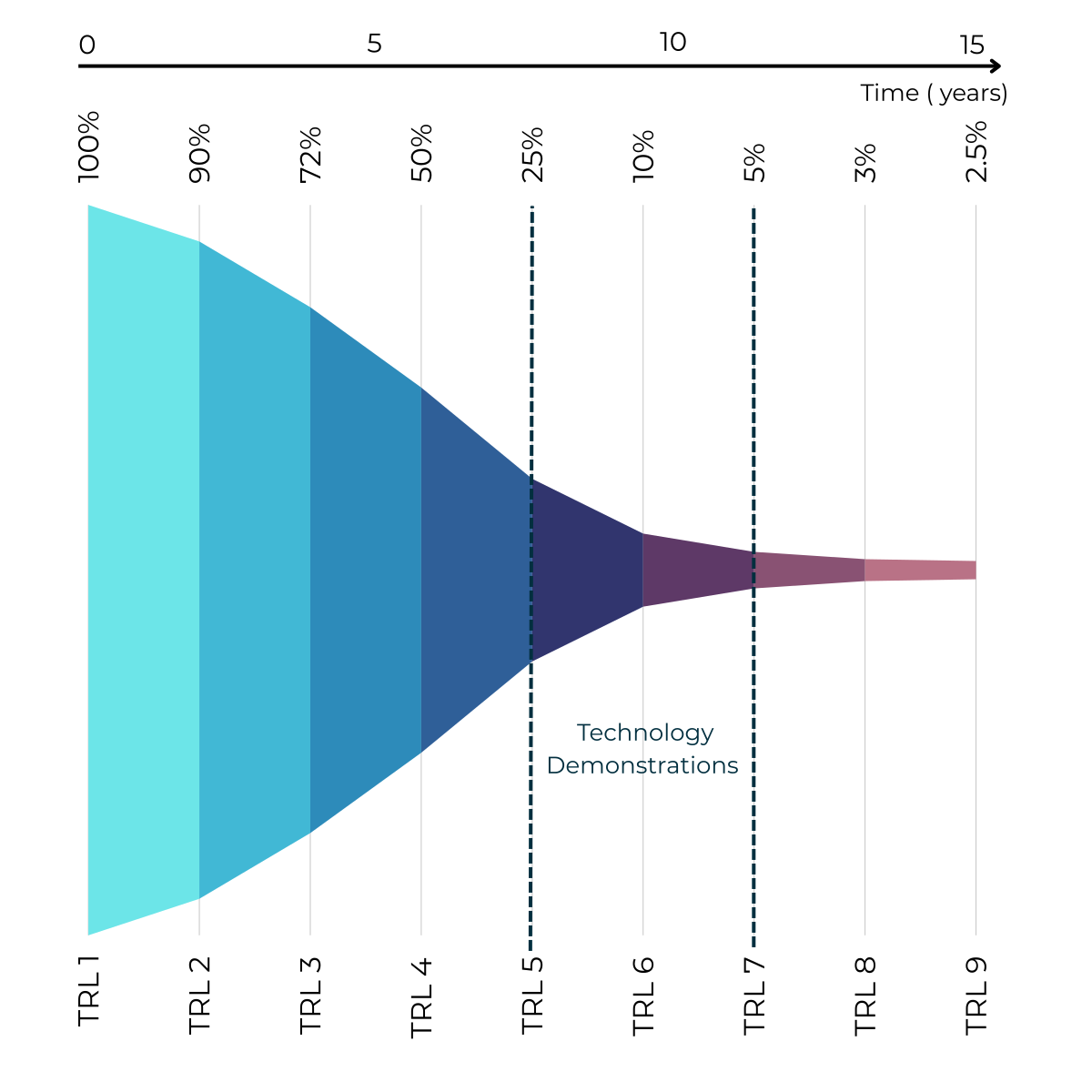
When you look at the innovation funnel for deeptech, the reality is sobering. It is a game of brutal attrition. We start with thousands of ideas, but as we move through the Technical Readiness Levels (TRL), the cumulative graduation rate, the percentage of projects that actually survive to the next step, drops off a cliff.
The Decade-Long Gauntlet
In the world of software, funnels move in months. In deeptech, we are looking at a timeline of a decade or more. Because the stakes are higher and the physics of moving atoms is harder and takes longer, the Valley of Death, which coincides with the demonstration phase (TRL 5–7), is not just a metaphor. It is a graveyard.
From a distance, the data tells a clear story. Very few companies graduate from this phase.
For many industrial actors, TRL 7 is the magic number. It is the point where the technology is proven in an operational environment and the risk for the incumbent is significantly reduced. Naturally, legacy companies prefer to engage here. It feels safe. It feels professional.
However, waiting for TRL 7 to engage is a strategic liability. By the time a startup reaches this stage, the window for influence has closed. The architecture is set. The supply chain is locked.
To truly leverage disruption, legacy industry must stop waiting for the finished product and start leading the demonstration phase.
Adults and Children: A Relationship of Responsibility
If we are honest, the relationship between an industrial incumbent and a deeptech startup is often like that of an adult and a child. The startup is full of energy and disruptive potential, but they lack the experience, infrastructure and regulatory understanding required to survive the real world of industrial scaling.
The legacy industry has the requirements, market access and operational grit. Yet too often, startups are treated as if they should be born fully grown. Help is offered only after they have already survived the hardest part of the journey.
This is a mistake.
Leading the Demonstration Phase
Legacy industry has both a responsibility and a massive opportunity to guide startups through the demonstration phase. Doing so requires a shift in how collaboration works.
- Requirement leadership. Startups should not have to guess what industrial-grade actually means. Industrial partners must set the bar early.
- Validation bridges. Providing testing environments and real-world data that simply cannot be replicated in a lab.
- Relationship equity. Building deep collaboration during the difficult teenage years so that when the technology matures, you are not just a customer. You are a partner.
The Strategic Payoff
When an industrial player actively guides a startup, the outcome is a de-risked path to either long-term collaboration or strategic acquisition. You are not buying a mystery box. You are integrating a technology you helped shape.
The funnel will always be narrow at the end. Attrition is inevitable. But needless waste of European brilliance is not. When legacy industry leads the demonstration phase, we do more than de-risk technology. We secure industrial sovereignty.
It is time for the adults to step up. Europe’s future does not depend on how many ideas we generate, but on how many we have the grit to deploy.
Want to discuss the column? Reach out to Magnus Ahlstedt, or join the conversation on Nordic Hardtech's Linkedin.
Lately ⏮️
Selected news from the hardtech ecosystem
- Vinnova and Vetenskapsrådet will open a joint call in spring 2026 to fund new excellence clusters aimed at making Sweden globally competitive in breakthrough technologies.
By turning textile waste into structured data and high-quality material streams, the company enables real, industrial-grade circularity. Cyclothe is currently raising capital and looking for strategic investors to scale deployment across Europe.
Reach out:
halit.kosmaz@cyclothe.com
LinkedIn: Halit Kosmaz
- Xshore’s electric boat factory in Nyköping may restart under new ownership, with Norway-based Fortivo taking over the facility. A reminder that hardtech assets often outlive the companies that built them.
- ICEYE has secured a multi-year contract to deliver sovereign SAR-based intelligence capabilities to the Swedish Armed Forces, reinforcing Europe’s shift toward commercial space systems for defense.
- Photoncycle has completed testing of its full-scale solid hydrogen storage pilot and is preparing to build its first factory, with Denmark as an initial market. Sifted has the full story.
Up next ⏭️
What's brewing in the community?
- SeaPattern is hiring a senior mechanical design engineer to lead mechanical development of its next-generation floating hydropower systems, from CAD and materials to production-ready turbine clusters. Apply here!
- TRATON is hiring a battery cell development engineer to build in-house cell capability at group R&D level, strengthening control over requirements, suppliers and series integration for heavy electric vehicles.
- Tistel is hiring a robotics engineer to build AI-driven unmanned vehicle systems, focusing on ML inference on constrained hardware, navigation algorithms and production-ready code for real-world deployment. Read more!
- Marble is looking for a CEO and co-founder to lead a new battery company focused on next-generation Li-ion manufacturing, with lower costs, higher energy density and reduced emissions.
- 🧠 Neutec is soon running workshops as part of a pre-study toward a neuromorphic technology excellence cluster, spanning materials to systems across telecom, edge AI, defense and industrial applications. Join in Lund in January or in Norrköping in February.
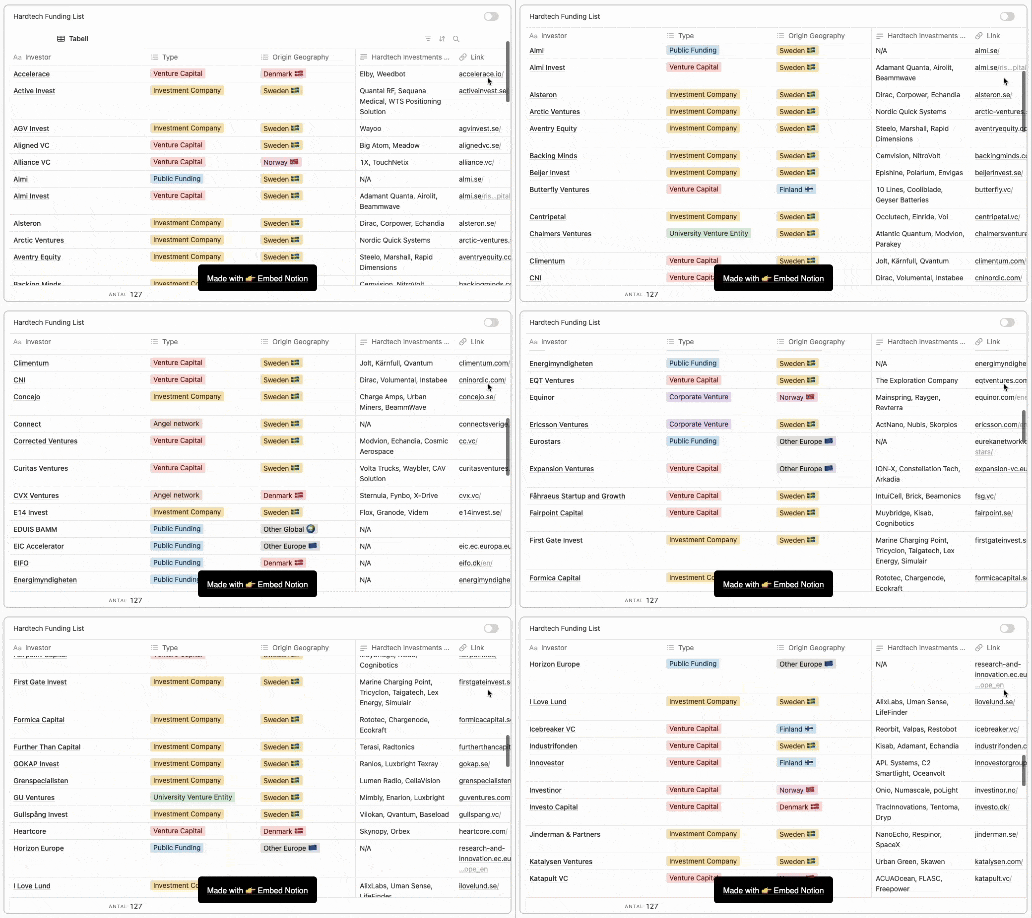
Nordic Hardtech Funding List
See who’s raising, scaling and building across the Nordics.
Nordic Hardtech is a platform for the hardtech ecosystem — sharing knowledge, bringing inspiration, and building community through podcasts, newsletters, events, and more.
💸 Fuel up. Scaling takes capital — The Nordic Hardtech Funding List shows you where to find it.
💥Get involved. Pitch a topic. Join the podcast. Get on the investor list– if you're hardtech.
→ Spotify | LinkedIn | nordichardtech.com
📩 hello@nordichardtech.com