Less cloud.
More matter.
Progress has always been physical. As the silicon era reaches its limits, Nordic hardtech founders are part of a global Material Renaissance — a shift in how materials drive innovation and resilience. From graphene and carbon composites to CO₂-made plastics, they’re turning matter itself into the next platform for technology.
Also in this issue: Sweden launches new tech clusters, Finland makes TIME’s inventions list, and Norway and Denmark double down on hardtech.
Nordic Hardtech Partners 🤝
Nordic Hardtech is a community for builders of complex tech companies based on physical products. Here are some of our outstanding partners.
- Lightbringer: AI-powered patent service helping tech companies protect their edge fast, with in-house legal expertise. Book an intro.
- Recuro: Growth partner for hardtech and deeptech. Scale with profit.
- SISP (Swedish Incubators & Science Parks): The network for 60+ incubators and science parks in Sweden. Find yours here.
- The Yard: Gothenburg’s hub for co-working, community, and serious hardware. Explore their memberships.
Nordic Hardtech Radar
This Week: From efficiency to endurance
Matter Over Code: The Nordic Path to Resilient Technology
For decades, progress in tech was measured in code lines and transistor counts. Moore’s Law became gospel: smaller, faster, cheaper. Silicon built the digital world — but as its physics approach natural limits and new materials unlock fresh potential, innovation is beginning to shift. The next revolution might not be digital at all. It’s material. And across the Nordics, that shift is already underway.
Across the Nordics, a new generation of deep-tech founders is re-engineering the very building blocks of industry. From graphene composites to carbon-based polymers, they are turning matter itself into a platform for innovation – perhaps not a replacement for silicon, but a new layer of progress built upon it.
One of them is Graphmatech, based in Uppsala. The company’s polymer-graphene composites have already reduced hydrogen leakage by up to 83 percent compared with conventional materials, offering a glimpse of what’s coming next: materials that don't just endure stress, they enhance performance.
In an Q&A with Sustainable Business Magazine, founder Dr. Mamoun Taher explained how the company’s breakthrough works:
“Our unique Aros Graphene keeps graphene layers separate, enabling large-scale industrial use of inexpensive graphene.”
Graphmatech’s work represents one side of the new material frontier — the microscopic engineering of atomic structures. On the other lies a more systemic shift: using materials themselves to replace entire resource chains.
In Finland, NG Nordic is taking that approach literally. The company has partnered with ABB Oy Wiring Accessories to launch INGA plastic, a new material based on captured CO₂ that replaces fossil-based plastics in everyday electrical components.
As Tony Rehn, Carbon2x Programme Director at NG Nordic, recently said in a press release:
“This collaboration is an excellent example of how companies are genuinely striving to solve global challenges and promote the circular economy. The use of various recycled and carbon-dioxide-based materials instead of fossil raw materials is key to mitigating climate change.”
The same mindset is driving research across the Nordics. At MAX IV in Lund, the world’s most powerful synchrotron gives startups atomic-level insight into new material behaviours, revealing how innovation happens at the smallest scales. And at Origin by Ocean, based in Finland, they are replacing oil-based chemicals with algae-derived polymers.
 Jennifer Bark
These are no longer research curiosities — they are industrial strategies. As Europe scrambles to rebuild manufacturing resilience and reduce supply-chain dependencies, material science has become an economic defence. The companies that control the next generation of alloys, polymers and conductive fibres will not just define new products; they will define new industries.
A recent General Catalyst insight put it succinctly:
“Resilience is the new efficiency. Companies that embed it as a core strategy today will be better positioned to withstand disruption.”
For the Nordic hardtech scene, that message resonates deeply. Small markets, high energy costs and strict regulations have always forced founders here to think systemically. Now that constraint is becoming a strength. When batteries, circuits and materials merge into unified systems, integration is everything. And that is where Nordic engineers excel.
The shift is not for the impatient. Material innovation takes time, capital and persistence — and everyone in this field knows it. But that endurance is also what gives it meaning.
As Graphmatech puts it on its website:
“We are not just creating materials; we are shaping the future of industries with every breakthrough.”
It’s fair to say the next era will blur the line between code and matter. Software will still drive progress, but through materials that are smarter, stronger and more adaptive. The ones who endure may not be the fastest, but the most deliberate.
"Developing novel materials for sustainable industrial scale", as Graphmatech puts it.
Lately ⏮️
Selected news from the hardtech ecosystem
- Sweden’s future tech push kicks off: Vinnova launches 45 projects to form world-leading clusters in AI, quantum, materials and more. Support phase opens now.
- Finland’s innovation engine turns up as five Finnish breakthroughs land on TIME’s Best Inventions 2025 list. From sustainable heating to gesture control, the country proves size isn’t everything.
- Norway lands Europe’s first AI gigafactory. Aker ASA and Nscale partner with OpenAI on “Stargate Norway” — a $1 bn hydropower-driven facility for large-scale AI infrastructure.
- Denmark boosts defence tech spending to strengthen Arctic and North Atlantic capabilities, investing €3.7 B in drones, AI surveillance and under-sea infrastructure.
- Swedish-led Arctial plans Europe’s first new aluminium smelter in 30 years — a low-carbon project in Finland backed by Rio Tinto, Vargas Holding and Mitsubishi. FID expected 2026-27.
Up next ⏭️
What's brewing in the community?
- As Europe rebuilds its industrial resilience, the CEE region is becoming a key partner for Nordic deeptech. Meet the ecosystem in Warsaw, Oct 27–29.
- Digital Tech Summit returns to Copenhagen Nov 5–6. This is where research meets industry to shape Denmark’s digital future. Sign up, it's free!
- Europe’s founders meet in Helsinki as Slush 2025 sets the stage for a new “ground state” of innovation, where AI, atoms and ambition collide. Nov 19–20, get your ticket.
Stay close to the capital
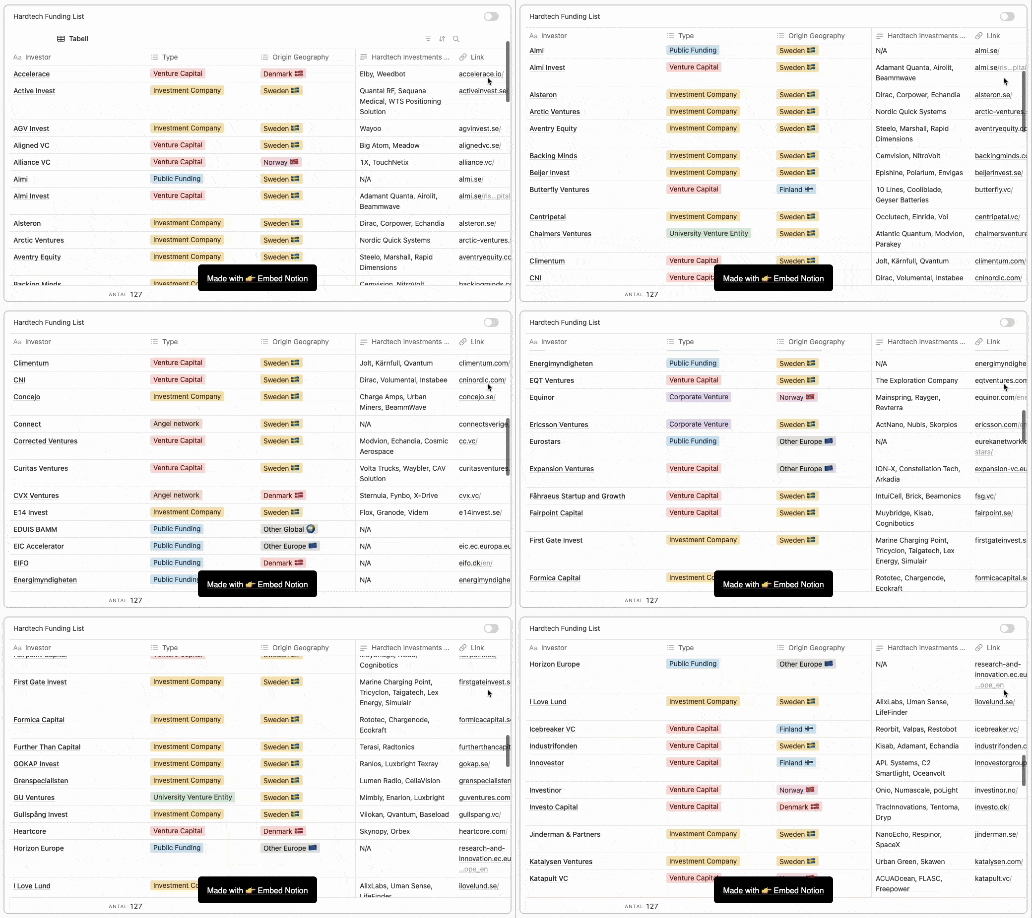
Check out the Nordic Hardtech Funding List — updated weekly with hundreds of deeptech and hardtech frontrunners across the region.
Nordic Hardtech is a platform for the hardtech ecosystem — sharing knowledge, bringing inspiration, and building community through podcasts, newsletters, events, and more.
💸 Fuel up. Scaling takes capital — The Nordic Hardtech Funding List shows you where to find it.
💥Get involved. Pitch a topic. Join the podcast. Get on the investor list– if you're hardtech.
→ Spotify | LinkedIn | nordichardtech.com
📩 hello@nordichardtech.com
    <picture><img class="kg-signup-card-image" src="/images/content/f227326276-Nordic-Hardtech---Digital-assets--square---5-.png" alt=""></picture>

        <div class="kg-signup-card-content">

            <div class="kg-signup-card-text ">
                <h2 class="kg-signup-card-heading"><span>Sign up for Nordic Hardtech</span></h2>
                <p class="kg-signup-card-subheading"><span>The platform for leaders of hardtech</span></p>

    <form class="kg-signup-card-form" method="post" action="https://nordichardtechnvotf6lc-forms.functions.fnc.fr-par.scw.cloud/">
        <div class="kg-signup-card-fields">
            <input class="kg-signup-card-input" name="email" type="email" required placeholder="Your email">
            <input type="text" name="website2" tabindex="-1" autocomplete="off" style="position:absolute;left:-9999px" aria-hidden="true">
            <button class="kg-signup-card-button kg-style-accent" type="submit">Subscribe</button>
        </div>
    </form>

                <p class="kg-signup-card-disclaimer"><span>Don't worry it's free. No spam. Unsubscribe anytime. </span></p>
            </div>
        </div>
    </div>